press Enter to searchSearch results:No products found.
What does RoseCraft mean by “Always Hand-Built”?
By
How RoseCraft Slip Joint Knives Are Really Made
(And Why “Handmade” Still Means What You Think It Means)
There are a few misconceptions floating around about how RoseCraft builds its traditional slip joint knives, so let’s clear the air. The truth is simple: our knives are every bit as hand-built and handmade as any other manufactured slip joint knife on the market. Every company—big, small, old, or new—relies on a mix of machines and skilled hands. RoseCraft is no different, and honestly, that’s exactly how traditional knife manufacturing works today.
Let’s break it down.
Machines Start the Process for Everyone
No matter the brand, every slip joint knife starts the same way: you have to cut pieces from raw materials.
RoseCraft uses a precision cutting machine to cut out its blade blanks.
Other brands either do the same or use a die press to stamp out blanks.
Same goes for grinding. Every blade needs to be ground to spec, and every manufacturer uses machinery for that step. RoseCraft uses a precision grinding machine that a worker feeds—just like other companies using similar equipment or older setups like a Nicholas Grinder. Despite what some folks imagine, factory workers aren’t standing there hand-grinding each blade like in the early 1900s. Those days are long gone.
And the story continues with handles. Every company must make bolsters and liners:
RoseCraft CNC mills bolsters and liners from a single piece of steel. This costs a little more because of material loss, but it makes for incredibly strong, integral construction.
Other brands typically use a die press to form the bolster onto the liner, then trim the parts with another press.
So yes—every slip joint manufacturer uses machines. That’s just efficient, modern production. But here’s where things get interesting.
From This Point On, It’s All Hands
Once the pieces are cut, shaped, and ready, the rest of a RoseCraft slip joint knife is built entirely by hand with the aid of standard shop machinery. This is the heart of the process, and it’s where skill truly matters.
A RoseCraft craftsperson:
Hand-assembles, hand-fits, and hand-pins every single knife – with a hammer and hand tools
Hand-hafts each one so the covers, pins, shields, bolsters, and liners meet perfectly with smooth transitions
Hand-sharpens every blade to a razor edge
Hand-cleans, oils, and polishes each knife before it’s considered finished
Then comes quality control. This part surprises a lot of people:
Every RoseCraft slip joint knife is hand-tested twice—once at the factory, then again when it lands in Maryville, Tennessee. We literally open, unwrap, check, and repackage each one before it ever heads your way.
That’s a lot of hands-on work for every single piece. And yes—this absolutely qualifies as a handmade, hand-built process in the world of traditional slip joint knives.
The Real Difference? Old Machines vs. New Machines
When you zoom out, RoseCraft and most other slip joint knife makers follow the same formula. The only real differences are the types of machines used at the very beginning—whether a company uses die presses or CNC mills, older grinders or newer ones.
But after that? It’s all human hands, careful fitting, real craftsmanship, and the same traditional methods that slip joint fans have appreciated for generations.
So next time someone asks whether RoseCraft knives are “really” hand-built, know this: they’re every bit as handmade and hand-built as the slip joint knives collectors and users have loved for decades—just made with a smart blend of modern tech and skilled craftspeople.
2 replies to “What does RoseCraft mean by “Always Hand-Built”?”
Paul
Hey guys! Thank you for this article! It answered a lot of questions I had. As someone who has only bought 3 of your factory “seconds” (or however it is you classify them) I was blown away at their quality! I couldn’t find a single thing wrong with them! In my eyes they are perfect! Almost scary perfect! I watched a YouTube review on your knives where the reviewer said that because of the precision of your knives, they were “soulless”. This article completely shuts down that opinion! I live in Knoxville and would love to stop by and say hi someday! Would that be possible! Keep up the great work!
P.s. is a barn wood or a saw cut knife handle every going to happen?
Thanks for your comment! We appreciate it. We’ve always laughed a little bit at the idea that because something is clean and well done that it’s somehow untouched by human hands or “soulless”. We take pride in what we do and how we do it. That’s why we’ve made the effort to show folks just how that happens.
We do have our first barn-board jigged knife coming very soon. Hang in there. We think you’ll love it.
RoseCraft uses genuine bone for some of the covers on their traditional slip joint pocketknives. Bovine bone is usually collected from cows raised for their meat. It’s cleaned, dried, and then prepared for use in our traditional pocketknives. Oh, and it’s gorgeous all by itself. Bone covers have natural texture, coloring, and pattern, and no …
You ever stop and think about the hoopla surrounding slip joint knives? It’s got me thinking – who decided they’re not tough enough for real work? Seems like we’ve lost touch with our roots. Before all these fancy locking mechanisms – before flippers and thumb studs were a twinkle in a knife designer’s eye – …

What does RoseCraft mean by “Always Hand-Built”?
How RoseCraft Slip Joint Knives Are Really Made
(And Why “Handmade” Still Means What You Think It Means)
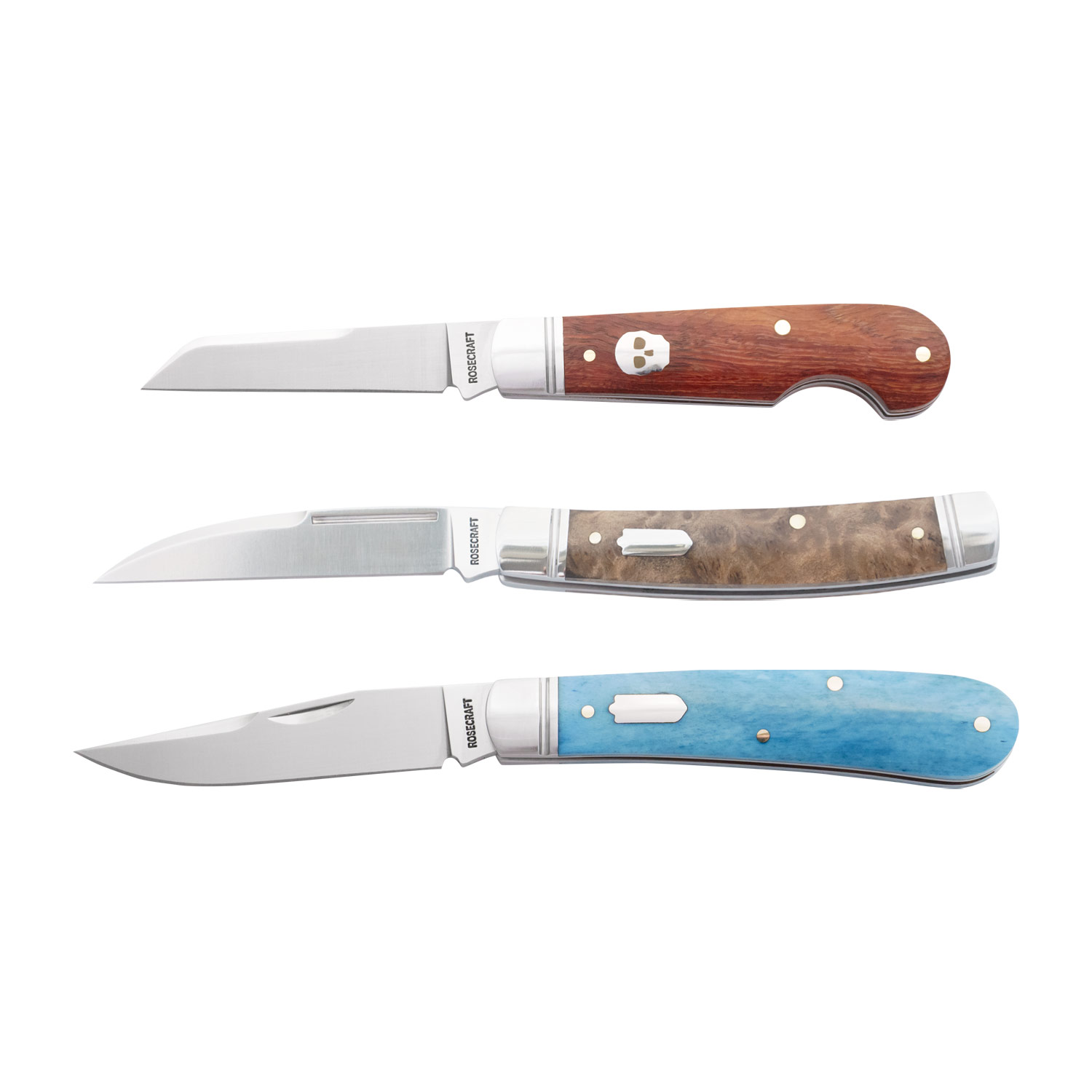
There are a few misconceptions floating around about how RoseCraft builds its traditional slip joint knives, so let’s clear the air. The truth is simple: our knives are every bit as hand-built and handmade as any other manufactured slip joint knife on the market. Every company—big, small, old, or new—relies on a mix of machines and skilled hands. RoseCraft is no different, and honestly, that’s exactly how traditional knife manufacturing works today.
Let’s break it down.
Machines Start the Process for Everyone
No matter the brand, every slip joint knife starts the same way: you have to cut pieces from raw materials.
Same goes for grinding. Every blade needs to be ground to spec, and every manufacturer uses machinery for that step. RoseCraft uses a precision grinding machine that a worker feeds—just like other companies using similar equipment or older setups like a Nicholas Grinder. Despite what some folks imagine, factory workers aren’t standing there hand-grinding each blade like in the early 1900s. Those days are long gone.
And the story continues with handles. Every company must make bolsters and liners:
So yes—every slip joint manufacturer uses machines. That’s just efficient, modern production. But here’s where things get interesting.
From This Point On, It’s All Hands
Once the pieces are cut, shaped, and ready, the rest of a RoseCraft slip joint knife is built entirely by hand with the aid of standard shop machinery. This is the heart of the process, and it’s where skill truly matters.
Then comes quality control. This part surprises a lot of people:
Every RoseCraft slip joint knife is hand-tested twice—once at the factory, then again when it lands in Maryville, Tennessee. We literally open, unwrap, check, and repackage each one before it ever heads your way.
That’s a lot of hands-on work for every single piece. And yes—this absolutely qualifies as a handmade, hand-built process in the world of traditional slip joint knives.
The Real Difference? Old Machines vs. New Machines
When you zoom out, RoseCraft and most other slip joint knife makers follow the same formula. The only real differences are the types of machines used at the very beginning—whether a company uses die presses or CNC mills, older grinders or newer ones.
But after that? It’s all human hands, careful fitting, real craftsmanship, and the same traditional methods that slip joint fans have appreciated for generations.
So next time someone asks whether RoseCraft knives are “really” hand-built, know this: they’re every bit as handmade and hand-built as the slip joint knives collectors and users have loved for decades—just made with a smart blend of modern tech and skilled craftspeople.
Take a look for yourself.
2 replies to “What does RoseCraft mean by “Always Hand-Built”?”
Paul
Hey guys! Thank you for this article! It answered a lot of questions I had. As someone who has only bought 3 of your factory “seconds” (or however it is you classify them) I was blown away at their quality! I couldn’t find a single thing wrong with them! In my eyes they are perfect! Almost scary perfect! I watched a YouTube review on your knives where the reviewer said that because of the precision of your knives, they were “soulless”. This article completely shuts down that opinion! I live in Knoxville and would love to stop by and say hi someday! Would that be possible! Keep up the great work!
P.s. is a barn wood or a saw cut knife handle every going to happen?
RoseCraft Blades
Thanks for your comment! We appreciate it. We’ve always laughed a little bit at the idea that because something is clean and well done that it’s somehow untouched by human hands or “soulless”. We take pride in what we do and how we do it. That’s why we’ve made the effort to show folks just how that happens.
We do have our first barn-board jigged knife coming very soon. Hang in there. We think you’ll love it.
Comments are closed.
Related Posts
RoseCraft’s Bone Covers celebrate the Nature of Bone!
RoseCraft uses genuine bone for some of the covers on their traditional slip joint pocketknives. Bovine bone is usually collected from cows raised for their meat. It’s cleaned, dried, and then prepared for use in our traditional pocketknives. Oh, and it’s gorgeous all by itself. Bone covers have natural texture, coloring, and pattern, and no …
Let’s talk about RoseCraft Red!
Andy and Swaggs talk about RoseCraft Red – the signature color of RoseCraft Blades. Wanna see what we have in RoseCraft Red, click here: RoseCraft Red
Is a slip joint a work knife?
You ever stop and think about the hoopla surrounding slip joint knives? It’s got me thinking – who decided they’re not tough enough for real work? Seems like we’ve lost touch with our roots. Before all these fancy locking mechanisms – before flippers and thumb studs were a twinkle in a knife designer’s eye – …